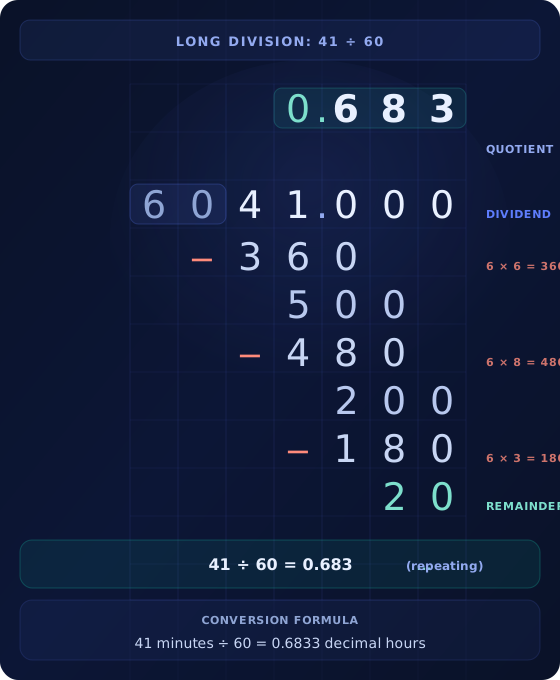
Minutes to decimal is the process of converting a time value expressed in minutes (or hours and minutes) into a decimal number. Instead of writing 1 hour 30 minutes, you write 1.50 decimal hours.
The decimal form represents the same duration but uses base-10 notation, which makes arithmetic operations like addition, subtraction, and multiplication straightforward. For example, adding 1.75 + 2.33 + 0.83 = 4.91 decimal hours requires no carry-over math. In clock format, 1:45 + 2:20 + 0:50 must be grouped into 60-minute blocks before it can be totaled.
Decimal hours are used across payroll, billing, and project workflows:
- Payroll calculations — decimal hours multiply directly with hourly pay rates for accurate wage computation.
- Project costing — task durations in decimal form integrate with budgeting and billing systems.
- Spreadsheet software — SUM and AVERAGE functions work cleanly with decimal values.
- Time tracking software — platforms can export approved time in invoice-ready decimal format.
- Reporting workflows — decimal values can be sorted, averaged, and audited in payroll exports.
For most teams, the important rule is consistency: use the same rounding precision across timecards, approvals, and payroll reports.